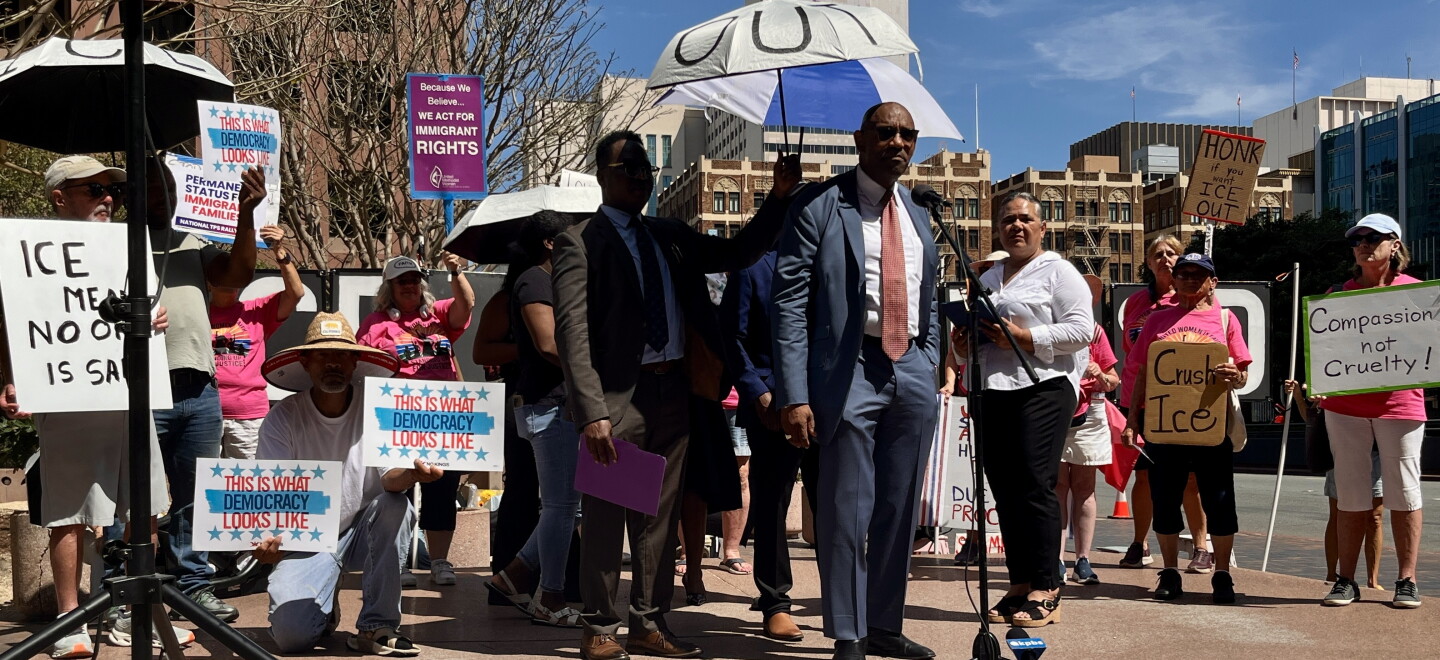
In July, the Trump administration stripped temporary protected status (TPS) from more than 500,000 Haitian nationals in the United States.
Here in San Diego, the community is trying to cope with this new reality.
“Us Haitians, we are very big in finding ways to be self-reliant,” said Wister Gaetan, cofounder of the nonprofit Haitian Bridge Alliance.
The organization advocates for fair and humane immigration policies for migrants. Gaetan is among the nearly 12,000 Haitians immigrants living in San Diego County. He said a strong work ethic is a shared characteristic.
“(They’d work) a whole 12-hour shift, then find themselves in the Mid-City community college learning English, taking skills training, improving their chance of actually establishing and becoming more self-reliant,” Gaetan said.
Gaetan has seen dozens of Haitian immigrants succeed in the region, but along with the second Trump administration comes the realization that they are at risk of losing everything they’ve worked hard for.
Many now find themselves without the ability to work legally and are at risk of detention and deportation.
From inflammatory rhetoric to policy changes
President Donald Trump began vilifying Haitians before he was reelected. In his debate with former Vice President Kamala Harris on Sept. 10, 2024, he falsely claimed Haitians were eating neighborhood pets.
“In Springfield, they’re eating the dogs,” Trump said while discussing immigration. “The people that came in, they’re eating the cats. They’re eating — they’re eating the pets of the people that live there.”
Officials in Springfield, Ohio, have publicly stated the claim was false.
After becoming president, Trump eliminated humanitarian parole and temporary protected status for Haitians and Syrians. These programs allow people to live and work in the United States when conditions in their home country prevent them from returning.
Without that legal protection, Haitian immigrants can now be detained and deported.

Arrest sparking fear
That happened on Sept. 8, when U.S. Immigration and Customs Enforcement (ICE) stopped two Haitian students on their way to class at San Diego City College. Renatho Kemsley Casseus was arrested. The other student fled onto campus.
That incident is reverberating in the Haitian community. Everyone is affected — even those with legal status, Roseline said. She didn’t want to give her last name out of fear. Her children are U.S. citizens but were terrified of being detained by ICE.
“Every day they try to talk to me,” she said. “They really scared because at school they talk to them too. They explain to them the situation. Even though they’re born here, they don’t really feel safe.”
She runs a daycare center out of her East County home. Some of her Haitian clients were either too afraid to leave the house or had already lost their job. Either way, she was losing customers.
And she has no easy answer to her children’s questions about what would happen if she were detained by ICE. She doesn’t even know the answers herself.
“‘I don’t feel comfortable to live by myself. I don’t feel comfortable to live with somebody else. Who is going to pay the bills?’ These are the questions they ask me every day,” Roseline said.
Broken promises
Gaetan said he still believes in the American dream and America’s promises. It’s a country that respects the rule of law and provides opportunities that few others do, he said.
“The U.S. markets itself as an exceptional country where anybody who is seeking safety will have a safe home here,” Gaetan said.
But Trump’s policies are breaking that promise, the American exceptionalism that he and other Haitians grew up believing was what the United States stood for. Gaetan said he regularly hears from Haitian nationals struggling to find their place in Trump’s America.
“I’ve got phone calls of people calling me asking, ‘Is there a way that you could go and buy for me basic necessities for my children because I’m afraid to leave my house,’” he said. “Think about it, you have families with American-born children not able to go to a supermarket to buy milk, bread and eggs so that they can feed their kid breakfast because they are afraid that if they go out they’ll be taken by ICE.”
‘The rules kept changing’
Many of the most vulnerable people affected followed the rules and did everything they were supposed to do. That was the case of a woman who asked not to use her name because she lost her legal status. She was a doctor in Haiti who fled because of its gang violence.
"Coming here to ask for help, seeking the security of a country where human rights are respected and heard, a democratic country, yet that is not what anyone is experiencing. It doesn't feel that way.”— One Haitian woman, who asked that her name not be used, said.
She entered the U.S. legally through Processes for Cubans, Haitians, Nicaraguans, and Venezuelans (CHNV), a Biden-era humanitarian parole program. Trump terminated that program in 2025.
After losing parole, she was covered through TPS and had a work permit, which she used to work at a hotel and take English classes while also raising a toddler.
She lost her ability to work legally when Trump eliminated TPS in July. She spoke to KPBS in Spanish.
“Para mi es una falta de respeto así a la gente (To me, that is disrespectful to people),” she said.
She said she followed the rules, but the rules kept changing.
“Viniendo, pidiendo ayuda, que necesita seguridad en un país donde el derecho humano, si se respeta, se escucha, un país democrático y uno no lo está viviendo (Coming here to ask for help, seeking the security of a country where human rights are respected and heard, a democratic country, yet that is not what anyone is experiencing),” she said. “No se siente asi (It doesn’t feel that way).”
As with many Haitians, the doctor still has hope. She was able to file an asylum claim, which comes with a work permit. She is still waiting for the permit to be processed, which could take up to six months.
KPBS reporters Marielena Castellanos and Alexander Nguyen contributed.